Stage 3: Hochstetten-Dhaun — Hildegard’s Visions
·
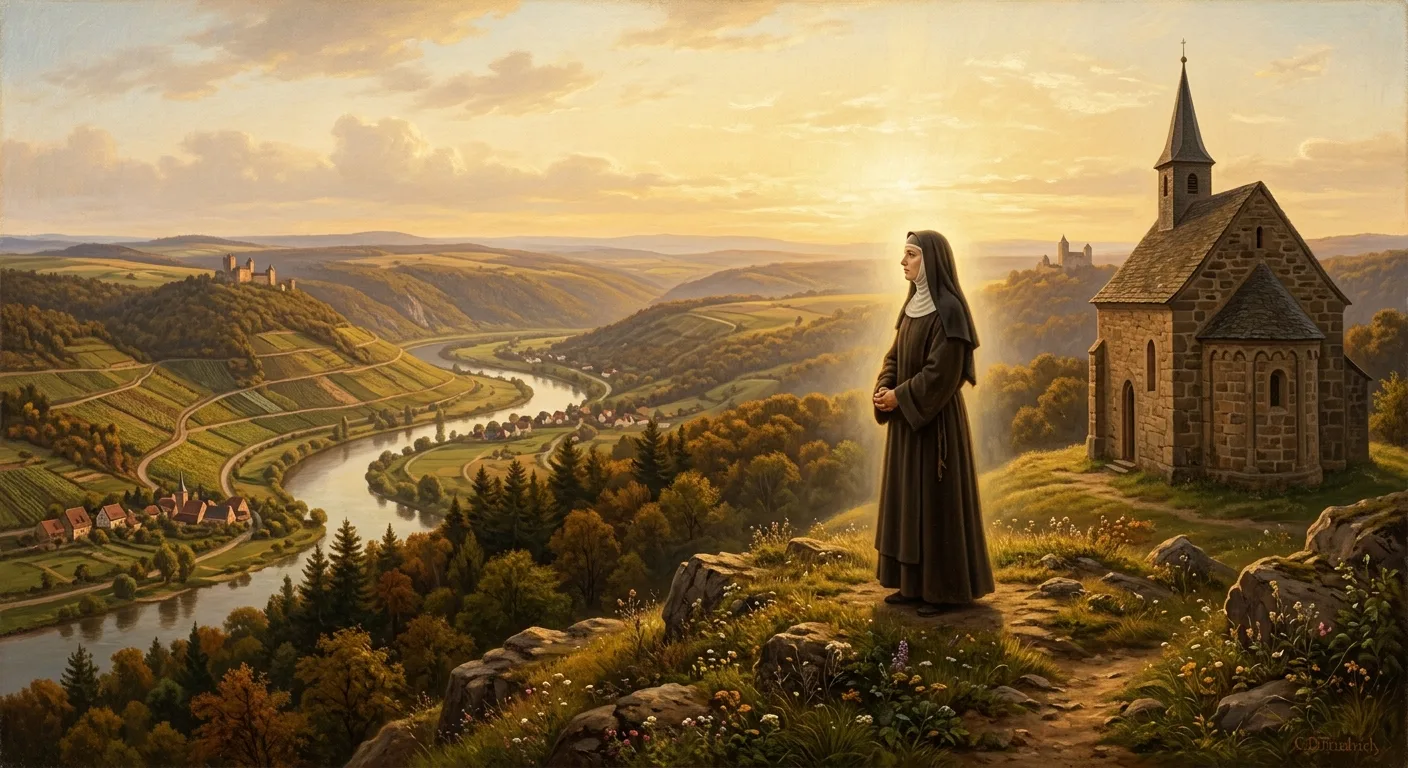
The third stage of the Hildegardweg climbs to Hochstetten-Dhaun, where the old Protestant church of St. Johannisberg sits on the heights above the Nahe valley. From here, the landscape opens — vineyards and river and forest stretching in every direction. It is the kind of view that makes the invisible feel close.
This is where Hildegard speaks about her visions. It is an appropriate setting. The elevated perspective, the silence, the sense of looking out over a world that does not know it is being watched — these are qualities that run through everything Hildegard wrote about her inner life.
Hildegard Speaks: On Her Visionary Experience
In her text for this third stage, theologian and Hildegard scholar Dr. Annette Esser renders Hildegard’s own account of the visions she carried — and concealed — for most of her life.
“In the third year of my life, I saw such a great light that my soul trembled. Until my fifteenth year, I saw much, and I talked about some of it so that those who heard were amazed. Therefore I kept this vision that I saw in my soul as secret as I could. Only at the age of 43 did I reveal myself to my dear brother Volmar. In this vision, I have seen the Living Light. I see, hear and know all at once — and I learn what I know in an instant.”
Hildegard von Bingen, as rendered by Dr. Annette Esser
The Living Light
Hildegard’s visions were unlike the ecstatic states described by many mystics. She did not lose consciousness. She did not fall into trance. She received what she called the lux vivens — the living light — with her eyes open, in full awareness, while continuing to go about the ordinary work of her day. The visions arrived alongside life, not instead of it.
She described the experience as seeing, hearing, and knowing all at once — an instantaneous comprehension that bypassed ordinary sequential thought. What she saw in the light, she held in memory. What she held in memory, she eventually wrote down — in the Scivias, in the Liber Vitae Meritorum, in the Liber Divinorum Operum — three major visionary works that together represent one of the most sustained records of mystical experience in the medieval period.
That she waited until age 43 to speak publicly was not cowardice. It was caution. A woman claiming divine visions in 12th-century Germany needed the right moment, the right allies, and the right framing. She found all three — and changed the course of her life entirely.
Stage 3 — Hochstetten-Dhaun
Hildegard carried her visions in silence for forty years before speaking them aloud. Walking the trail where she lived those years is its own kind of revelation. Download our free Pilgrim’s Guide to the Hildegard Way.
About This Series
This post is part of a ten-stage series walking the Hildegardweg — drawing on Saint Hildegard Speaks by Dr. Annette Esser, published by Crazy Wisdom Publishing. Learn more about the Saint Hildegard Way pilgrimage journey or get in touch.