Stage 9: Bingen — Hildegard Founds the Rupertsberg
·
The Hildegardweg ends in Bingen am Rhein — at the vaulted cellar of the Rupertsberg, all that remains of the monastery Hildegard founded in 1150, and then across the river at the pilgrimage church of Eibingen, where her relics are kept. The trail that began in Idar-Oberstein, in the gem-rich hills of her birthplace, concludes here at the river where she chose to plant her greatest work.
There is a pilgrimage saying: the way itself is the goal. But arriving at Bingen also matters. It is where Hildegard’s life reached its fullest expression — not in the enclosed world of Disibodenberg, but in a monastery she built herself, on a hill above the confluence of the Nahe and the Rhine, at the center of the Empire she had decided to address.
Hildegard Speaks: On the Foundation of the Rupertsberg
In her text for this ninth and final stage, theologian and Hildegard scholar Dr. Annette Esser gives voice to Hildegard’s account of the move that redefined her life — and what it meant to build something from nothing, at the age of fifty-two.
“Anno Domini 1150, when I was 52 years of age and therefore already an old woman, I moved with 19 of my sisters to the Rupertsberg in Bingen. Despite the resistance of the Disibodenberg monks we finally found generous sponsors for our new foundation. The monastery developed splendidly. It does not consist of magnificent yet imposing buildings — but what is well arranged is that one has routed water-pipes into every room. So I finally wish to say that this is true — that my life in our convent in Bingen on the Rhine, in spite of all the hardship and testing, has been a great joy and a great gift to me till the end of my life.”
Hildegard von Bingen, as rendered by Dr. Annette Esser
A New Beginning at Fifty-Two
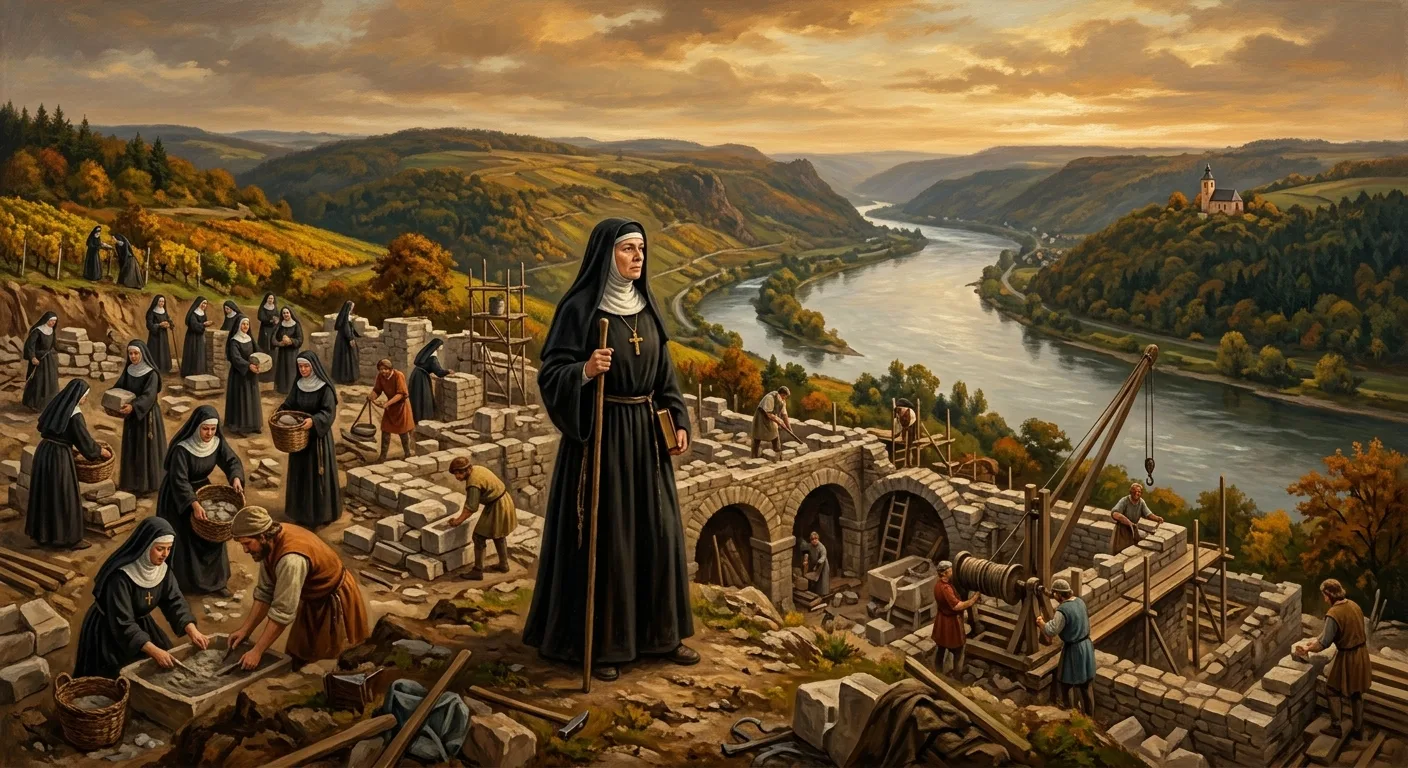
Founding the Rupertsberg was an act of will against considerable opposition. The monks of Disibodenberg did not want to lose Hildegard or the prestige and income her community brought. She persisted — through illness, through administrative resistance, through the logistical challenge of relocating nineteen sisters to an undeveloped hilltop site. The first years at Rupertsberg were hard. The noble sisters, unaccustomed to physical labor, found themselves on a building site.
What emerged was a community of nearly fifty sisters, a scriptorium, a library, running water piped to every room — a detail that struck the visiting monk Guibert of Gembloux as remarkable enough to record. The monastery became a center of intellectual and spiritual life that drew correspondence from across Europe. Hildegard continued writing, composing, preaching, and advising until her death at eighty-one.
The Rupertsberg was destroyed in the Thirty Years’ War. Only the vaulted cellar remains, now used as an event space in Bingerbrück. But across the Rhine, the pilgrimage church at Eibingen — the second monastery Hildegard founded in 1165 — still stands, and the Benedictine abbey above it continues in unbroken succession from her community. Her relics are there. The trail ends there. The living tradition continues.
Stage 8 — Rupertsberg
From this hillside above the Rhine, Rupertsberg is visible below — the place where Hildegard built her greatest work at fifty-two. If that story moves you, download our free Pilgrim’s Guide and start planning your own journey to the Rhineland.
About This Series
This post is the ninth in a ten-stage series walking the Hildegardweg — drawing on Saint Hildegard Speaks by Dr. Annette Esser, published by Crazy Wisdom Publishing. The tenth and final post in the series features Heather Boyle’s personal account of walking the Hildegard Way. Learn more about the Saint Hildegard Way pilgrimage journey or get in touch.