Day 11: Hildegard’s Music — Theology in Sound at the Abbey of Eibingen
·
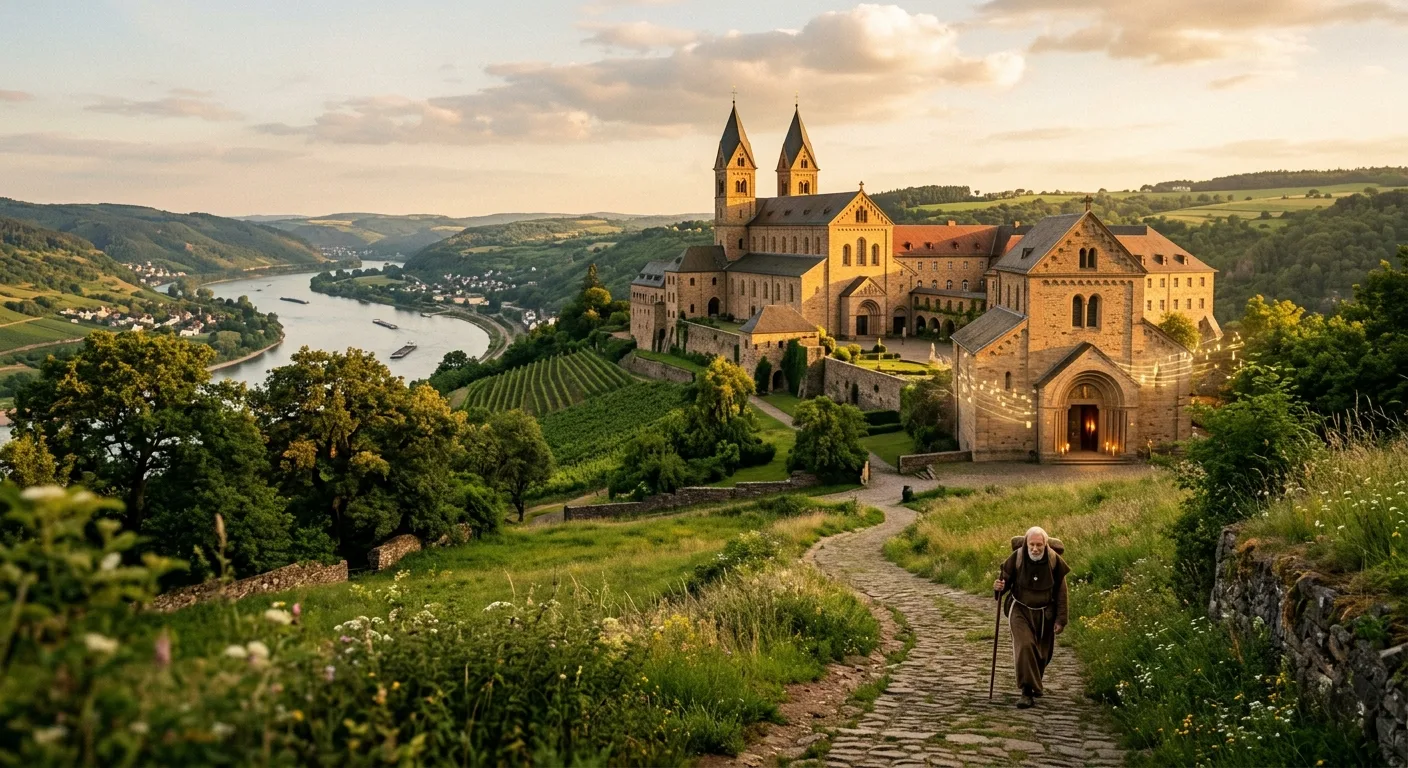
The Hildegardweg ends at the Abbey of Saint Hildegard in Eibingen — the living Benedictine community that continues in direct succession from the monastery Hildegard founded across the Rhine in 1165. The abbey church holds her relics. The sisters still sing her music in the liturgy. After nine stages through the landscape of her life, arriving here feels like the journey completing itself.
Day 11 of the virtual pilgrimage turns to what may be Hildegard’s most enduring gift: her music. Not as historical artifact, but as living theology — a body of chant that encodes her entire vision of creation, redemption, and the feminine divine in sound.
Music as Theology
Hildegard did not compose music as an ornament to her theology. For her, music was theology — the most direct form in which the human voice could participate in the harmony of creation. She believed that the original human beings sang in paradise, and that the Fall had silenced that song. The role of sacred music was nothing less than the restoration of the primal harmony between earth and heaven.
This is why, in 1178, when the canons of Mainz placed an interdict on her monastery — forbidding the celebration of the Mass and the singing of the Divine Office — Hildegard responded with one of the most extraordinary letters of her life. She did not simply argue for an exemption. She argued that to silence sacred song was a spiritual catastrophe, a severing of the thread between the human and the divine. The interdict was eventually lifted. The music continued.
In this session, theologians Dr. Katherine Wrisley Shelby and Dr. Travis Stevens explore how Hildegard’s chants teach her entire cosmology in miniature — how each antiphon is not merely a song but a compressed theological statement about creation, incarnation, and redemption. The session includes sung demonstrations of O Quam Mirabilis and O Frondens Virga, illuminating Hildegard’s radical positioning of Mary as the reversal of Eve — the feminine figure through whom creation is restored rather than lost.
Sister Hiltrud at Eibingen
The video also features Sister Hiltrud from St. Hildegard’s Abbey in Eibingen, speaking to pilgrims directly at the shrine. Her presentation — in German — unpacks the holistic dimensions of Hildegard’s teaching for those standing at the physical end of the Hildegardweg. It is a rare window into how the living community at Eibingen understands and transmits Hildegard’s legacy today.
The Two Paths
The session opens with Rev. Dr. Shanon Sterringer reading Robert Frost’s “The Road Not Taken” alongside Hildegard’s own final vision — the Two Paths: one leading through a garden of delights, one through mud. The juxtaposition is not incidental. Hildegard’s entire life was a sustained act of choosing the less traveled way — founding her own abbey, preaching in public, defending her community, composing music that broke every convention of her time.
Standing at the abbey in Eibingen, at the end of the trail, that choice is visible in stone and sound.
This post is part of the Saint Hildegard Way virtual pilgrimage series. Learn more about the pilgrimage journey or get in touch.