Hildegard’s Pilgrimages and Teaching Tours, Stage 7: Braunweiler
·
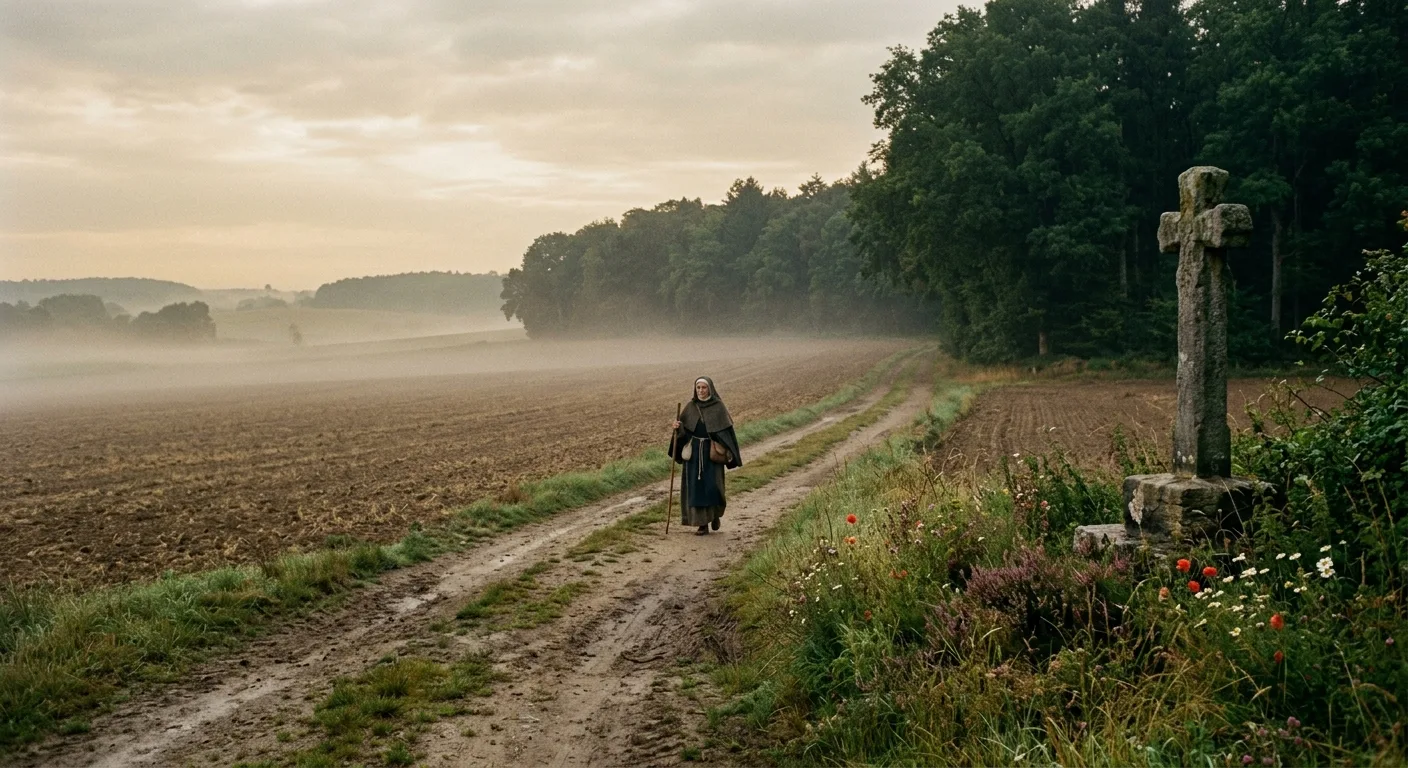
The seventh stage of the Hildegardweg moves through the fields and forest of Braunweiler — open farmland, a wayside cross at the edge of the trees, a path that crosses culturally from Protestant into more traditionally Catholic countryside. At Keber’s Cross, pilgrims pause. The landscape here carries a quality of threshold, inspired by Hildegard’s Pilgrimages.
This is where Hildegard speaks about pilgrimage itself — and about her own extraordinary preaching tours through the cities and monasteries of the Holy Roman Empire. She who spent forty years enclosed on a hilltop monastery eventually became one of the most widely traveled religious voices of her century.
Hildegard Speaks: On Pilgrimages and Her Teaching Tours
In her text for this seventh stage, theologian and Hildegard scholar Dr. Annette Esser gives voice to Hildegard’s account of the sacred tradition of pilgrimage — and her own role as a public voice in a world that rarely permitted women to speak.
“For myself, I have not been on a pilgrimage to the Holy Land, yet within the Empire, I had a far-reaching correspondence and finally, I have traveled a great deal in order to proclaim the Word of God. Known as the ‘trumpet of God’, yet sensing as a poor fearful little female, I was urged to speak to clergy, doctors and other scholars in important places. I traveled along the river Main to monastic communities in Mainz, Würzburg, Bamberg. Along the river Mosel, I traveled to Metz — and I have been preaching publicly in the cathedral town of Trier. Along the river Rhine, I came to Boppard, Andernach, Siegburg, Cologne and Werden.”
Hildegard von Bingen, as rendered by Dr. Annette Esser
The Trumpet of God
Hildegard undertook four major preaching journeys in the years after she founded the Rupertsberg — traveling the Main, the Mosel, the Rhine, and into Swabia. She preached in cathedral chapters, in monasteries, to clergy and to laypeople. She addressed the corrupt and the powerful and did not soften her message. In Cologne she called out the Cathar movement. In Trier she preached publicly in the cathedral on Pentecost Sunday — something almost without precedent for a woman in the 12th century.
She described herself, with characteristic mixture of authority and humility, as a “poor fearful little female” — una paupercula feminea forma. The phrase was both genuine and strategic. It disarmed critics while she proceeded to say exactly what she believed.
Walking the Braunweiler fields, moving from one tradition of faith into another, it is worth considering what it means to carry a message on foot — and what it cost, in the 12th century, to deliver one.
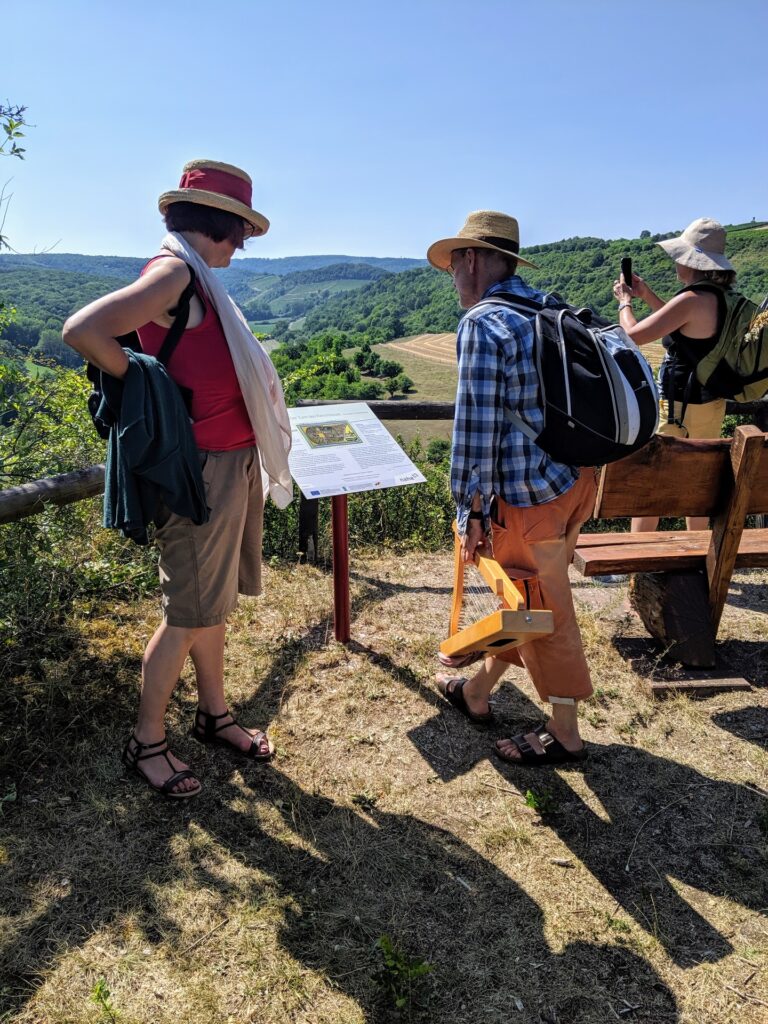
Stage 7 — Braunweiler
Hildegard traveled the rivers of the Holy Roman Empire preaching publicly at a time when women were not permitted to. Walking in her landscape is a different kind of encounter with that courage. Download our free Pilgrim’s Guide to the Hildegard Way.
About This Series
This post is part of a ten-stage series walking the Hildegardweg — drawing on Saint Hildegard Speaks by Dr. Annette Esser, published by Crazy Wisdom Publishing. Learn more about the Saint Hildegard Way pilgrimage journey or get in touch.