How Hildegard Gained Fame as a Seeress, Stage 8: Bingerbrück
·
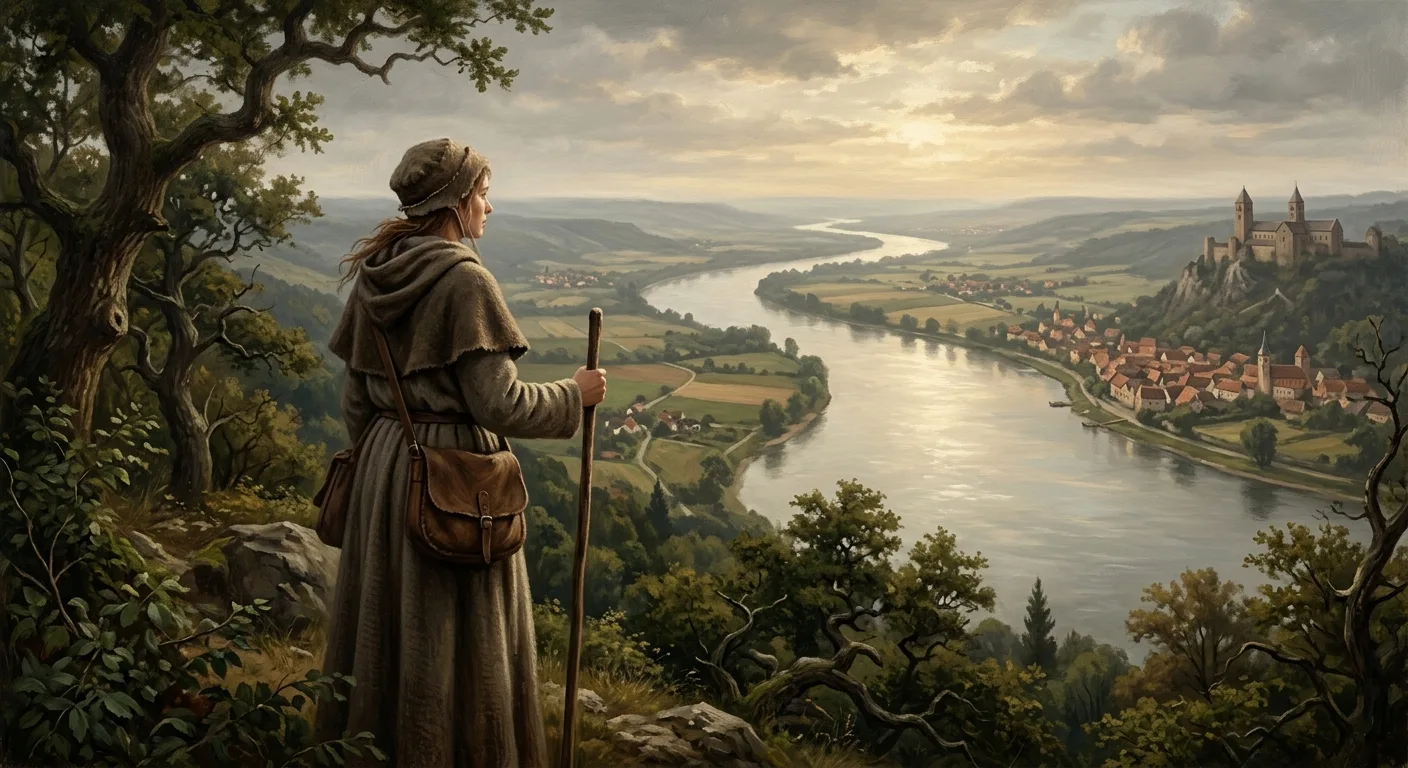
The eighth stage of the Hildegardweg descends through forest and streams toward Bingerbrück, where the trail opens onto a view that stops every pilgrim: the Rhine below, Bingen on the far bank, the wide river valley spreading out toward the horizon. From here it is not far to where Seeress Hildegard founded her first independent monastery at the Rupertsberg — the place she left everything she knew to build something entirely her own.
This is where she speaks about how she became known — how the visions she had kept secret for decades finally entered the world, and what it cost her, and what it gave her.
Hildegard Speaks: On Gaining Fame as a Seeress
In her text for this eighth stage, theologian and Hildegard scholar Dr. Annette Esser gives voice to Hildegard’s account of the moment she stepped, reluctantly and then irreversibly, into public life.
“I have held back the visions that I had since early childhood. I would never have talked about my visionary experience if God had not forced me to do so by means of a severe illness. As a faint-hearted woman, I did not want to leave my cause just in the hands of these men. Therefore I gathered all my courage and in 1147, I wrote a letter to abbot Bernhard of Clairvaux. I entrusted myself to him as ‘una paupercula feminea forma’ — a poor little female — and asked him to judge whether my vision could be from God. This is how I became well-known and how my fame as a seer grew throughout the whole Empire.”
Hildegard von Bingen, as rendered by Dr. Annette Esser
The Letter That Changed Everything
Bernard of Clairvaux was the most influential churchman of his age — reformer, preacher, the man who called for the Second Crusade and shaped the direction of 12th-century Christianity. Writing to him was an act of extraordinary audacity for an enclosed nun. Hildegard did it anyway, twice, because she needed his endorsement and she knew it.
Bernard’s eventual response was cautious but positive. More importantly, when Pope Eugene III convened the Synod of Trier in 1147, Bernard spoke in Hildegard’s favor. The Pope himself read aloud from the unfinished manuscript of the Scivias. He sent Hildegard a letter granting her apostolic license to continue writing and proclaiming her visions.
From that moment, the woman who had been an obscure magistra in a Rhineland hilltop monastery became a figure of European significance. Kings and popes wrote to her for counsel. Abbots sought her judgment. The woman who described herself as “a poor little female” became, in the words of her contemporaries, the “trumpet of God.”
Stage 8 — Bingerbrück
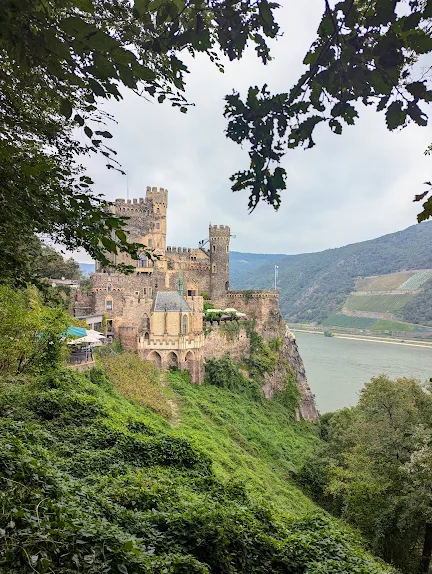
From this hillside above the Rhine, Bingen is visible below — the place where Hildegard built her greatest work at fifty-two. If that story moves you, download our free Pilgrim’s Guide and start planning your own journey to the Rhineland.
About This Series
This post is part of a ten-stage series walking the Hildegardweg — drawing on Saint Hildegard Speaks by Dr. Annette Esser, published by Crazy Wisdom Publishing. Learn more about the Saint Hildegard Way pilgrimage journey or get in touch.