Stage 10: On the Hildegard Way — A Modern Pilgrim’s Account
·
Every pilgrimage is two journeys at once — the outer route through geography, and the inner route through whatever you bring to it. Heather Boyle walked the Hildegard Way in the summer of 2019, alongside Dr. Annette Esser, Michael M. Conti, and a small group of theologians and pilgrims from four continents. This is her account of what she found.
On the Hildegard Way
By Heather Boyle, Group Tour Leader
In the summer of 2019, I had the privilege to walk the Hildegard Way with Dr. Annette Esser, my husband Michael M. Conti, two Hildegard theologians, and a small group of knowledgeable guides she had trained. It was magical. I had little idea what to expect, other than the photos I had seen of Disibodenberg and the surrounding countryside. The photos did not do justice to this beautiful part of the world.
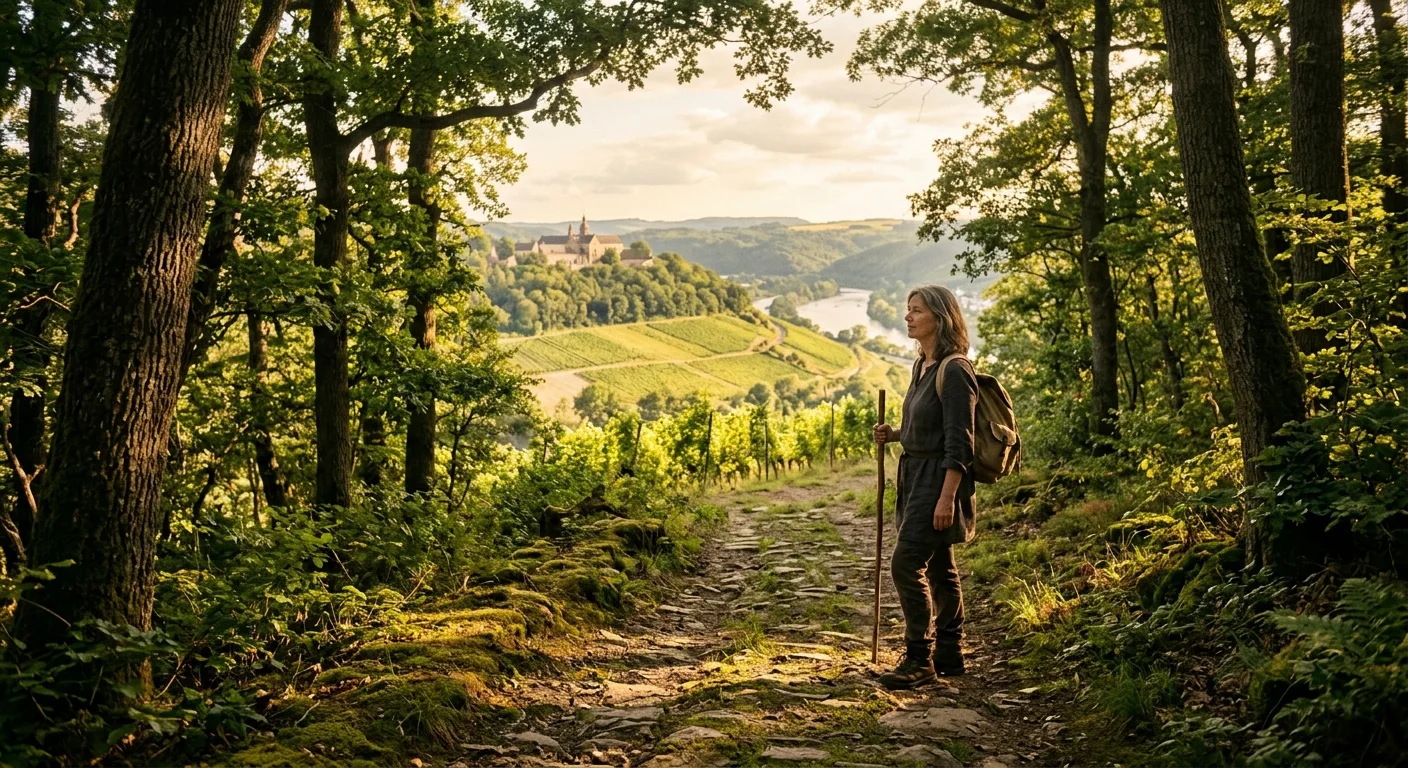
Despite the record heat that summer, and the weight of the camera gear we carried to film Dr. Esser speaking as Hildegard at different trail locations, I can’t imagine wanting my first time discovering the Hildegard Way to be any different. Walking through the coolness of the forest next to small creeks was contrasted with the lushness of vineyards on rolling hills with wide open vistas and golden fields of wheat and spelt. To my American eyes, the medieval towns and villages and churches we passed truly looked like something out of a fairy tale. When one is on the Hildegard Way, modern civilization seems very far away. The trail is pieced together in such a way that highways are rarely seen or heard, the majority of the visible buildings are stone and timeless, nature is continuously present as forest or farms.
A Secret Passageway
What surprised me most came at the end, when we finished the walk and I discovered how close to roads and industrialized towns we had actually been. The Hildegard Way may be just over the hill from the modern world — yet when you are walking the trail in the shady forest hearing nothing but songbirds, or in the sunny vineyards with the buzzing bees, you have been transported to a secret passageway. A small green then gold sliver of the world where time has slowed down. The natural world as seen by Hildegard in her time is still in existence, if you know where to look and are willing to walk to find it.
Dr. Esser stopped with us at several specific locations that are critical for understanding and appreciating the life of Hildegard. Starting in Idar-Oberstein, winding through Disibodenberg, Sponheim, Waldböckelheim and other lovely villages, and ending at the current Benedictine Abbey of St. Hildegard overlooking Rüdesheim and Bingen, Dr. Esser truly brought Hildegard to life.
Viriditas Underfoot
Although Hildegard is well-known within Germany, she remains a hidden mystery to many who are not Catholic or medieval history buffs. My initial introduction to Hildegard was through her music — the haunting chants she wrote specifically for women’s voices. That music written by a 12th century Benedictine nun could still remain so popular and relevant is thought provoking, to say the least.
As a modern woman, I deeply admire how many times Hildegard reinvented herself and allowed herself to grow and expand into new disciplines, well into her old age. She only started to write down her own music at age 42. She left the comfort of Disibodenberg with her nuns to found her own abbey at age 53. She continued to produce and create until her death at age 81 — nearly double the average lifespan at the time.
Hildegard spoke often of viriditas — the power of continual greening and renewal of life, of divine nature, of the power of humans to grow and to heal. Walking the Hildegard Way in the land of Hildegard, the spirit of viriditas becomes apparent and unmistakable, in the forests, fields, and farms. Viriditas is available to all. You only need to walk towards it.
About This Series
This is the tenth and final post in our series walking the Hildegardweg stage by stage — drawing on Saint Hildegard Speaks by Dr. Annette Esser, published by Crazy Wisdom Publishing. Heather’s essay appears in the book alongside Dr. Esser’s nine station texts. Learn more about the Saint Hildegard Way pilgrimage journey or get in touch.
Stage 10 — Heather’s Essay
Viriditas is available to all. You only need to walk towards it. Download our free Pilgrim’s Guide — 7 sacred sites, what to expect, and everything you need to start planning your Hildegard Way pilgrimage.