Inside the Abbey — sister Lydia on Hildegard’s Living Legacy
·
Abbey of St. Hildegard
Most visitors to the Abbey of Saint Hildegard in Eibingen experience it from the outside — the Romanesque tower above the Rhine, the pilgrimage church below, the reliquary behind the altar. Fewer get to sit down with one of the sisters and ask what it actually means to live in Hildegard’s tradition, nine centuries after her death.
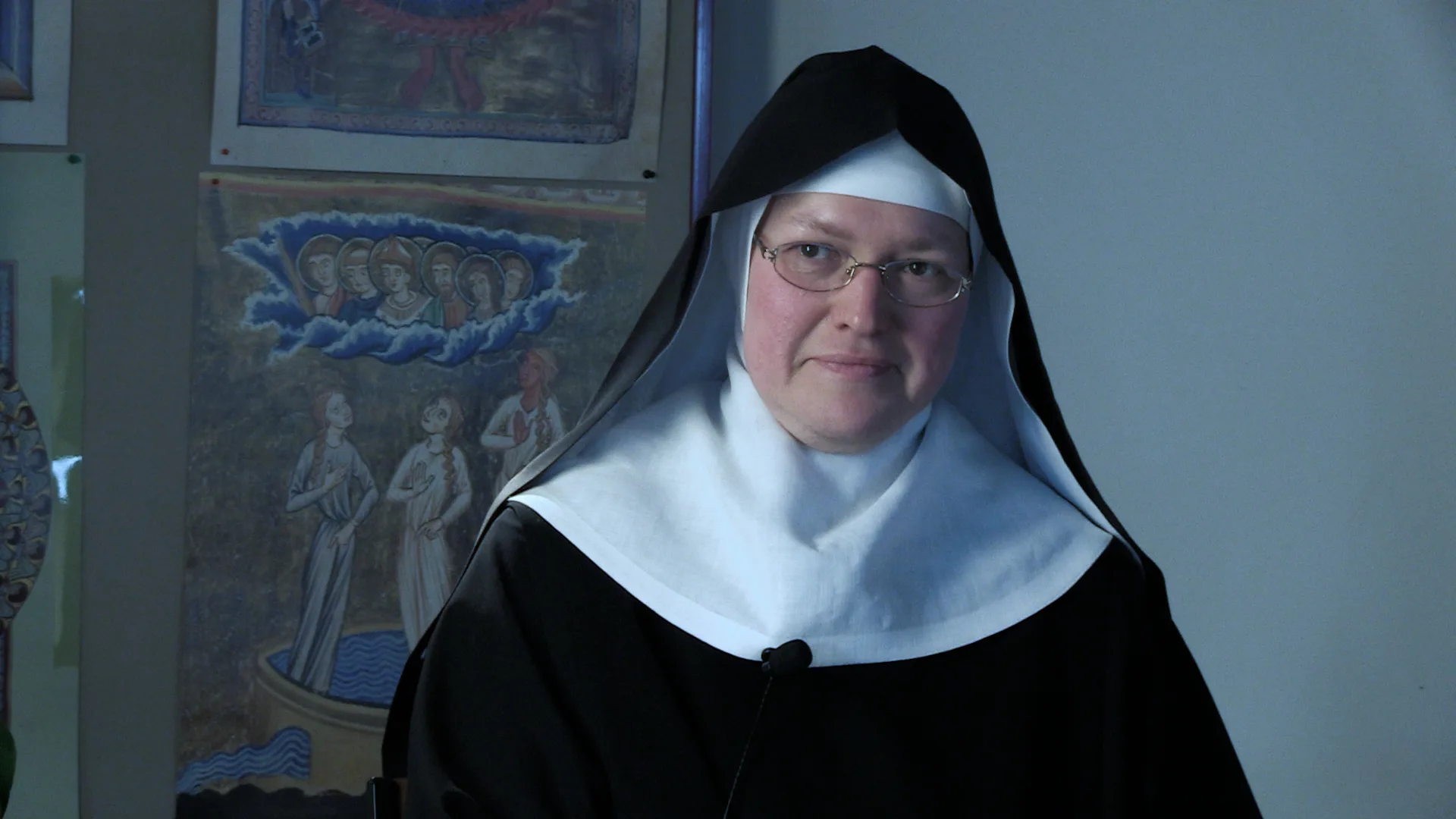
In this conversation, filmmaker Michael M. Conti speaks with Sister Lydia Stritzl of the Abbey of St. Hildegard — a wide-ranging discussion about Hildegard’s biography, her music, her medicine, her canonization, and what daily life looks like inside a Benedictine community that still measures its days by the Rule of Saint Benedict.
Doctor of the Church
Sister Lydia begins with the 2012 canonization — the moment Pope Benedict XVI formally declared Hildegard a saint and then, the same day, named her a Doctor of the Universal Church. She became only the fourth woman in history to receive that title, alongside Teresa of Ávila, Catherine of Siena, and Thérèse of Lisieux. For the community at Eibingen, it was both a celebration and a confirmation of what they had always known: that Hildegard’s teaching — her Scivias, her medical works, her music, her letters — was not merely historically interesting but theologically essential.
Sister Lydia describes Hildegard’s central message simply: God loves humanity, and that love flows over the world. The Latin phrase Caritas abundat — love abounds — runs through her writing like a river. It is the animating principle behind viriditas, behind her medical philosophy, behind her music. Everything Hildegard created was an attempt to make that love visible, audible, tangible.
The Songs That Came from Visions
On Hildegard’s music, Sister Lydia is precise: the 77 songs are not compositions in the conventional sense. They are the result of meditation, inseparable from her visions and from prayer. They are difficult — unusually wide in range, rhythmically free, structurally unlike anything else in medieval liturgical music. The sisters at Eibingen still sing them. The challenge of learning them is itself a kind of formation.
On her medicine, Sister Lydia addresses the question that scholars still debate: how much of Hildegard’s medical knowledge came from divine vision, and how much from the compiled learning of her time? Her answer is characteristically Benedictine — both, inseparably. Hildegard studied. She observed. She read. And she also received. The distinction between natural knowledge and mystical knowledge was not one she would have recognized.
The Reliquary and the Sweetness
Michael describes his own encounter with Hildegard’s reliquary in the pilgrimage church — an experience he has spoken about in several contexts: a quality of sweetness in the air near the shrine that he was not prepared for, and that seemed to draw those present into spontaneous, harmonious song. It is the kind of account that resists easy categorization, which is perhaps appropriate for a saint whose entire life was built on the conviction that the boundary between the visible and invisible is more permeable than we imagine.
Life by the Rule of Saint Benedict
The conversation turns to the life of the abbey itself — structured around the seven daily prayers, the Rule of Saint Benedict, and the mandate that the community earn its living by its own hands. The sisters manage seven hectares of vineyard. They run a shop. Sister Christoffer works in clay — her sculptures, like Annette Esser’s Jungfrau Hildegard at Disibodenberg, are a way of making belief visible. The primary requirement for entering the community, Sister Lydia says, is simply this: searching for God. Everything else — the creativity, the work, the particular charism each sister brings — follows from that.
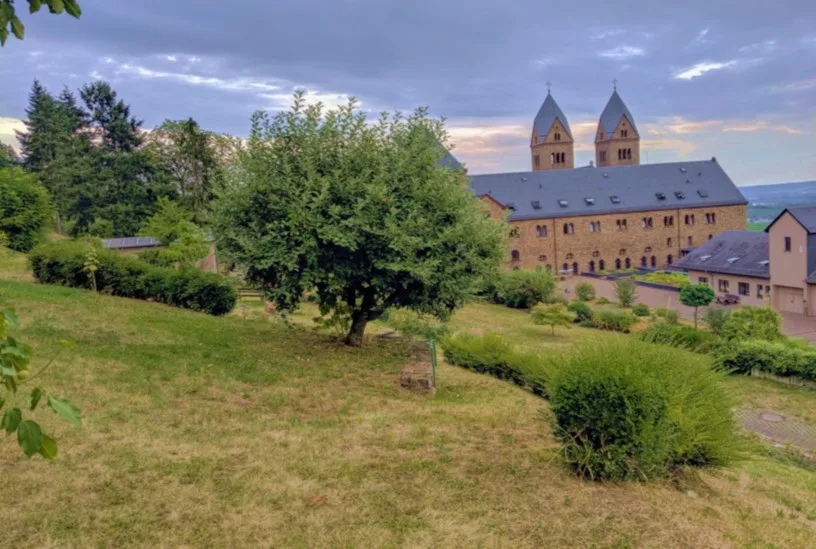
Standing at the end of the Hildegardweg, having walked the trail from Idar-Oberstein, it is worth sitting with that simplicity. Searching for God. That is what Hildegard was doing at three years old, when she first saw the light. It is what she was doing at eighty-one, when she died on the Rupertsberg with her community around her. It is what the sisters at Eibingen are doing now.
This post is part of the Saint Hildegard Way virtual pilgrimage series. Learn more about the pilgrimage journey or get in touch.