Stage 1: Idar-Oberstein — Where the Hildegard Way Begins
·
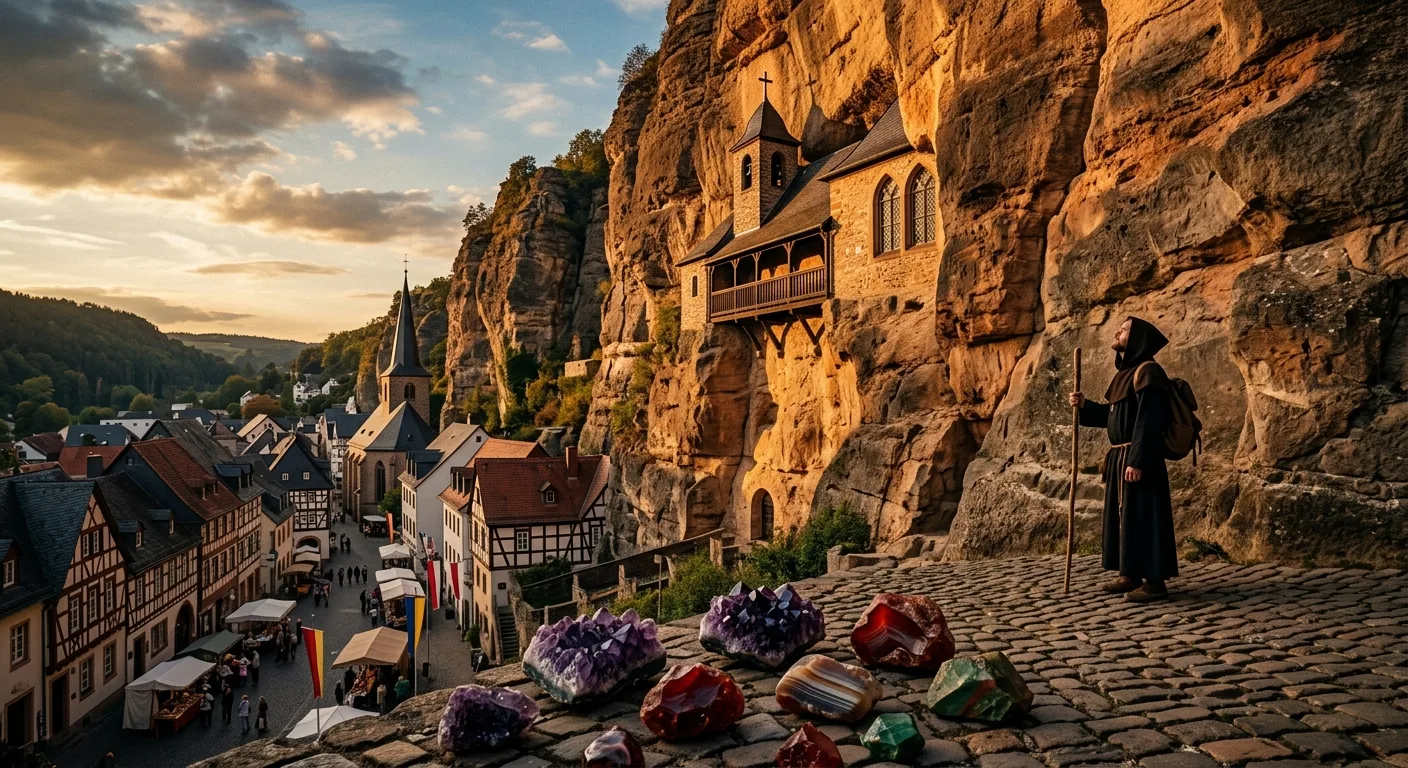
Every pilgrimage has a beginning. On the Hildegardweg, that beginning is Idar-Oberstein — a town literally built into the face of a cliff, where the famous Felsenkirche, the Church in the Rocks, juts from the sandstone above the old marketplace. It is a place that announces, from the first moment, that this is not ordinary countryside. Something older is present here.
Idar-Oberstein has been a center of gemstone mining and cutting since the Middle Ages. The rivers here — the Nahe and its tributaries — carried agates, jasper, and other precious stones from the surrounding hills. For centuries, this was one of the most significant gem-trading regions in the Holy Roman Empire. It is no accident that the Hildegardweg begins here. Hildegard von Bingen was born in this region, and she spent her life writing and thinking about precious stones — their beauty, their symbolism, their healing properties.
Hildegard Speaks: On Precious Stones and the Heavenly Jerusalem
In her text for this first stage of the Hildegard Way, theologian and Hildegard scholar Dr. Annette Esser gives voice to Hildegard herself — drawing on Hildegard’s own writings to let the saint speak directly to modern pilgrims. Standing at the old marketplace in Idar-Oberstein, looking up at the Felsenkirche, Hildegard’s words orient us to the whole journey ahead.
“Anno Domini 1098, I was born on this side of Gaul which is full of precious stones. Jewels have always delighted me. The Devil recoils in fear from gemstones. Thus I believe that precious stones can also protect humans and even have certain healing effects on them. After all, the Heavenly Jerusalem is also built from twelve jewels that can all be found in this area.”
Hildegard von Bingen, as rendered by Dr. Annette Esser
The twelve stones of the heavenly Jerusalem — jasper, sapphire, agate, emerald, onyx, carnelian, chrysolite, beryl, topaz, chrysoprase, jacinth, amethyst — were not abstract symbols to Hildegard. They were present in the earth around her birthplace. The landscape itself was sacred text.
Hildegard and the Healing Power of Stones
Hildegard’s interest in precious stones was not merely aesthetic or theological — it was medicinal. In her encyclopedic work Physica, she devoted an entire section to the properties of stones, describing how each gem carries particular energies and healing correspondences. Jasper strengthens the heart. Sapphire calms fever and temper. Emerald supports the eyes and the stomach. Her lapidary — her writing on stones — was one of the most detailed of the medieval period and drew on both ancient sources and her own visionary experience.
This is part of what makes Hildegard so difficult to categorize by modern standards. The same woman who wrote sophisticated theology and composed haunting liturgical music also catalogued hundreds of plants, animals, and minerals for their healing properties. She did not experience these as separate domains. The beauty of a sapphire and its capacity to heal were, for her, expressions of the same divine order.
Arriving in Idar-Oberstein
Pilgrims arriving in Idar-Oberstein stand at the old marketplace and look up at the Felsenkirche — the same view that opens this stage of the Hildegardweg. The church, built directly into a natural rock alcove in the 15th century, is one of the most striking in the Rhineland. Inside, medieval frescoes still decorate the walls. Below, the town’s gem museum traces the centuries-long tradition of stone cutting and trading that gave this region its character.
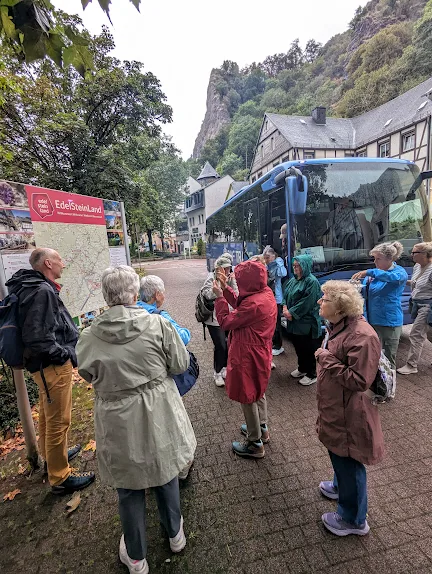
It is a fitting beginning. You are standing in the land Hildegard described as “full of precious stones.” The 85-mile walk to Bingen and Eibingen stretches ahead. The first step is always the most important one.
Stage 1 — Idar-Oberstein
The Hildegard Way begins here, in the land she described as “full of precious stones.” If you’re planning to walk it — or dreaming of it — download our free Pilgrim’s Guide: 7 sacred sites, what to expect, and what makes this trail unlike any other.
About This Series
This post is the first in a ten-part series walking the Hildegardweg stage by stage — drawing on Saint Hildegard Speaks: Uncovering the Life and Wisdom of Saint Hildegard von Bingen Through a Pilgrimage on the Hildegard Way by Dr. Annette Esser, published by Crazy Wisdom Publishing. In this book, Dr. Esser gives Hildegard her own voice — writing nine first-person texts in which the saint speaks about her life, her visions, her healing, and her world, each tied to a specific location on the trail. An ideal companion for anyone preparing for or reflecting on a pilgrimage on the Hildegard Way.
Learn more about the Saint Hildegard Way pilgrimage journey or get in touch if you have questions.