Stage 2: Niederhosenbach — Hildegard’s Family and Childhood
·
Niederhosenbach in the Hunsrück
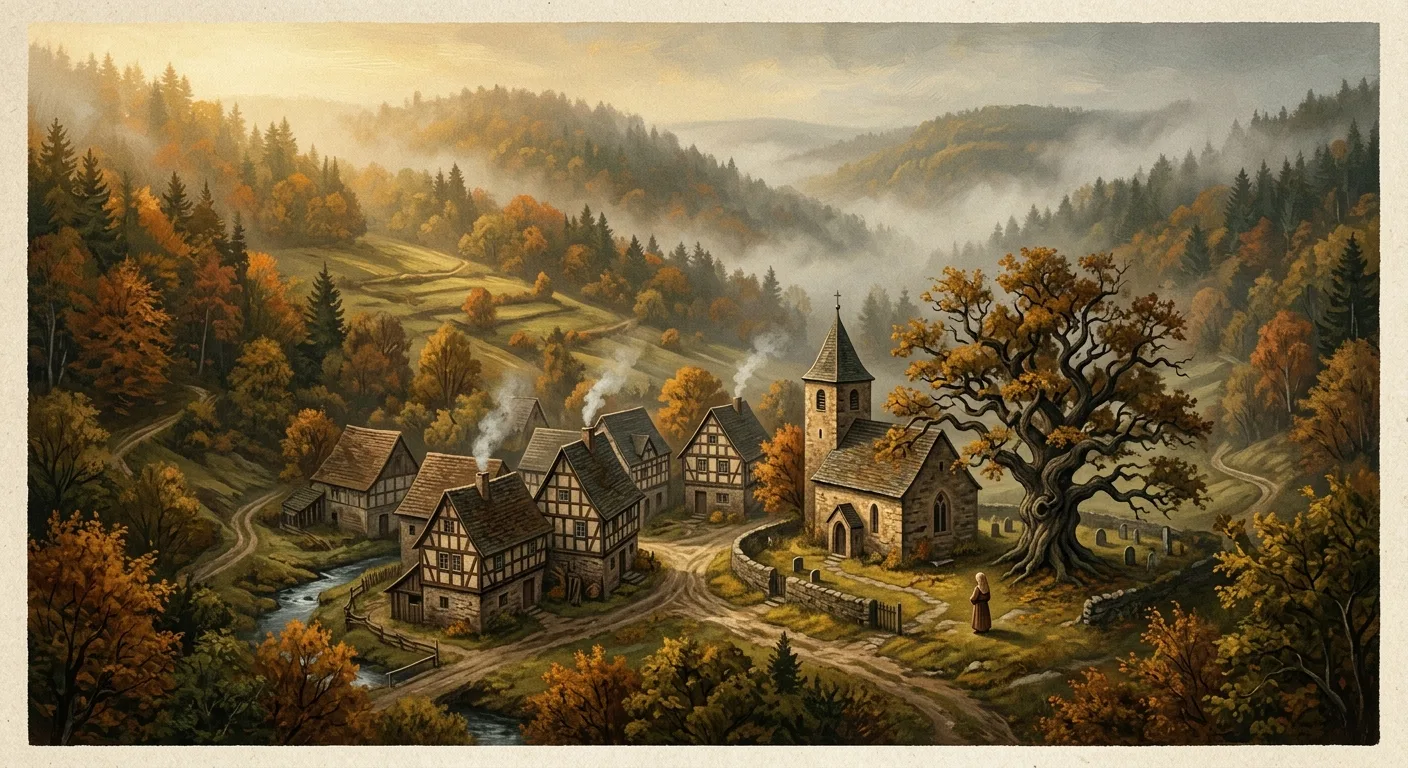
The village of Niederhosenbach barely appears on most maps. Tucked into the hills above the Nahe valley, it is the kind of place that time has left largely undisturbed — a cluster of farmhouses, a small Protestant church, an old oak tree in the churchyard. According to current historical research, this is where Hildegard von Bingen was born in 1098, the tenth child of a noble family whose estate dominated the surrounding land.
The Hildegardweg passes through Niederhosenbach on its second stage, walking from Herrstein through the Gem Road forests and descending into the village. Inside the church, a facsimile of Hildegard’s great visionary work, the Liber Scivias, is kept — a quiet acknowledgment that something remarkable began here.
Hildegard Speaks: On Her Family and Childhood
In her text for this second stage of the Hildegard Way, theologian and Hildegard scholar Dr. Annette Esser gives voice to Hildegard herself — drawing on Hildegard’s own writings to let the saint speak about her origins.
“My father Hildebrecht was the Lord of Bermersheim and Niederhosenbach. My noble mother Mechtild came from Merxheim. She gave birth to ten children. As the tenth child, my parents dedicated me to God while sighing — just as one gives the tithe of the harvest to the Church. As a child, I was often ill, and I saw things that others found only peculiar or at best miraculous. In spite of all the love in the circle of my family, I was also often not understood and I was a lonely soul.”
Hildegard von Bingen, as rendered by Dr. Annette Esser
The Tenth Child
The practice of offering a tenth child to the Church — as a human tithe — was not uncommon in medieval noble families, but it was not without weight. Hildegard was given to a religious life before she could choose it. She was entrusted at age eight to Jutta of Sponheim, a noblewoman fourteen years old herself, who would become her teacher and companion for the next three decades.
What makes Hildegard’s account of her childhood striking is her honesty about its difficulty. She was frequently ill. She experienced visions from the age of three — light and sound that she could not explain and dared not describe. She was, in her own words, a lonely soul. The gifts that would eventually make her one of the most celebrated figures of the medieval world were, in childhood, sources of isolation and bewilderment.
She would not speak openly about her visions for another forty years. That silence — chosen, necessary, protective — is itself part of her story.
Walking Through Niederhosenbach
Pilgrims arriving in Niederhosenbach after the Gem Road descent find a village that still carries the quality of Hildegard’s description — remote, quiet, rooted in land and family. The old oak outside the church has stood for centuries. The surrounding hills are the same hills she knew as a child.
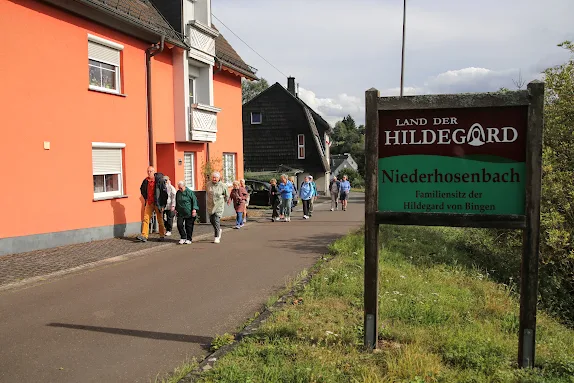
It is worth pausing here longer than the trail might suggest. This is not merely a waypoint. It is the place where the story begins.
Stage 2 — Niederhosenbach
Hildegard was born in this quiet valley and given to God before she could choose it. If her story is drawing you toward the Rhineland, download our free Pilgrim’s Guide and start planning your own journey.
About This Series
This post is part of a ten-stage series walking the Hildegardweg — drawing on Saint Hildegard Speaks: Uncovering the Life and Wisdom of Saint Hildegard von Bingen Through a Pilgrimage on the Hildegard Way by Dr. Annette Esser, published by Crazy Wisdom Publishing. Learn more about the Saint Hildegard Way pilgrimage journey or get in touch.