Stage 4: Monzingen — Hildegard’s Art of Healing
·
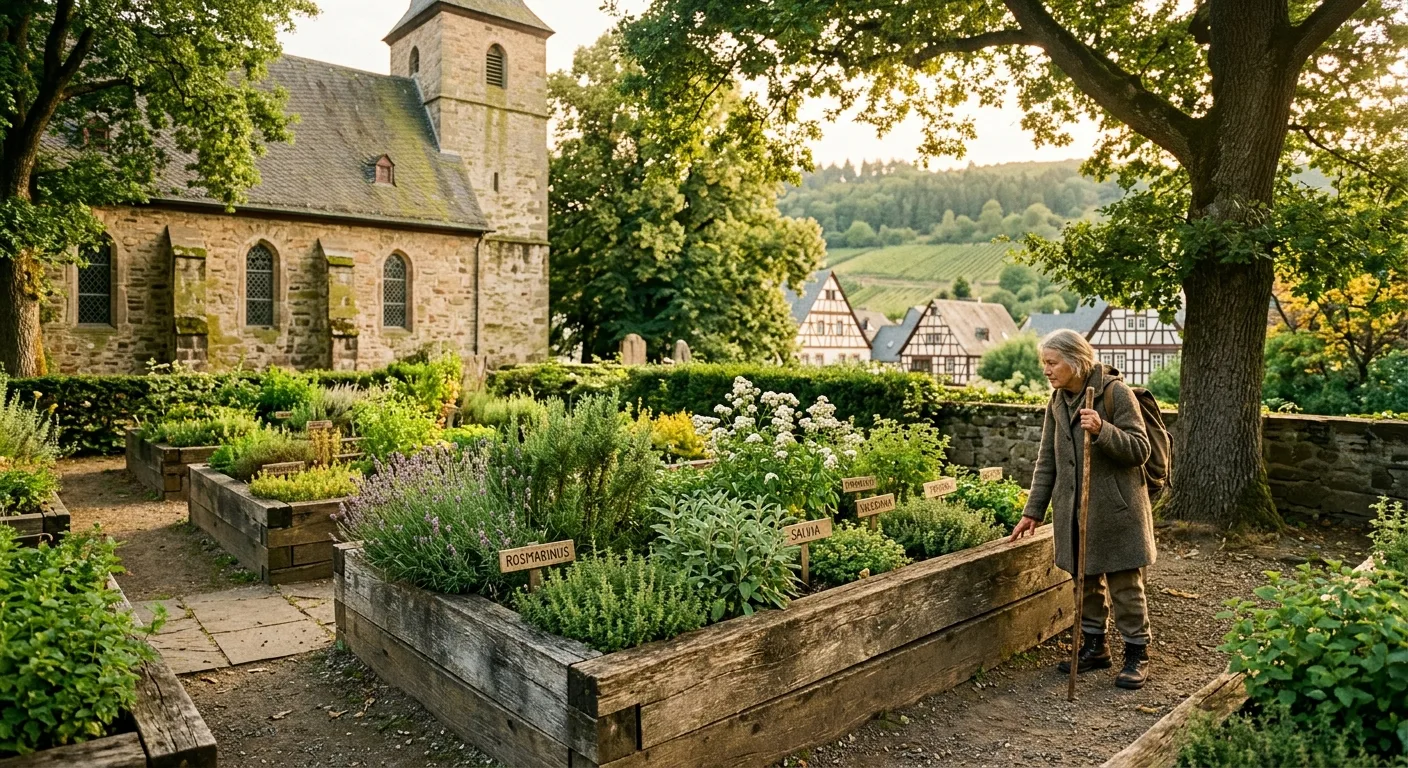
Monzingen herb garden
Hildegard’s two medical texts, Physica and Causae et Curae, catalogued the healing and harmful properties of hundreds of natural elements. Her method emphasized relational harmony between body, nature, and spirit, and her influence is still recognized in Germany as foundational to herbal and alternative medicine traditions.
The fourth stage of the Hildegardweg passes through Monzingen, where a medicinal herb garden grows behind the old Protestant church. It is a quiet, practical place — raised beds, labeled plants, the smell of earth and rosemary. For pilgrims who have been walking through forests and vineyards, it arrives as a moment of stillness and intention.
This is where Hildegard speaks about healing. It is exactly the right place to do so.
Hildegard Speaks: On Her Art of Healing
In her text for this fourth stage, theologian and Hildegard scholar Dr. Annette Esser gives voice to Hildegard’s account of how her medical knowledge was formed — not from divine dictation alone, but through decades of careful observation.
“In my time on the Disibodenberg I learned much about Benedictine monastic medicine. We had a cloister garden and a hospice into which the sick and suffering were brought and in which I spent much of my time. I also often sat at the Nahe and Glan rivers. There I looked at the fish in the water and the birds in the air. I sensed the healing power of the elements. God gave me the gift of — how shall I say this properly — ‘talking’ with plants and animals, to realize what kind of healing or harming effect certain plants could have for certain human illnesses.”
Hildegard von Bingen, as rendered by Dr. Annette Esser
Medicine as Encounter
Hildegard’s approach to medicine was grounded in the same philosophical framework as everything else she wrote. The body, like the natural world, was a system in relationship — with food, with season, with spirit. Health was not the absence of disease but the presence of harmony. Illness was what happened when that harmony drifted out of balance.
Her two medical works — Physica and Causae et Curae — catalogued hundreds of plants, animals, stones, and elements, each with its healing or harmful properties. But what distinguished her method was not the catalogue. It was the quality of attention that produced it. She did not simply read about plants. She sat beside rivers and watched. She worked in the hospice garden. She listened, in her own phrase, to what the plants were saying.
In Germany today, Hildegard is considered the founder of alternative medicine — a tradition of herbal and nutritional healing that draws directly on her writings. The Monzingen herb garden is one small expression of a living legacy.
Stage 4 — Monzingen
The Monzingen herb garden is a small, living expression of Hildegard’s eight-century-old medical legacy. If you want to stand in it yourself, download our free Pilgrim’s Guide and start planning your pilgrimage.
About This Series
This post is part of a ten-stage series walking the Hildegardweg — drawing on Saint Hildegard Speaks by Dr. Annette Esser, published by Crazy Wisdom Publishing. Learn more about the Saint Hildegard Way pilgrimage journey or get in touch.