Jutta of Sponheim, Hildegard’s Teacher – Stage 6: — Burgsponheim
·
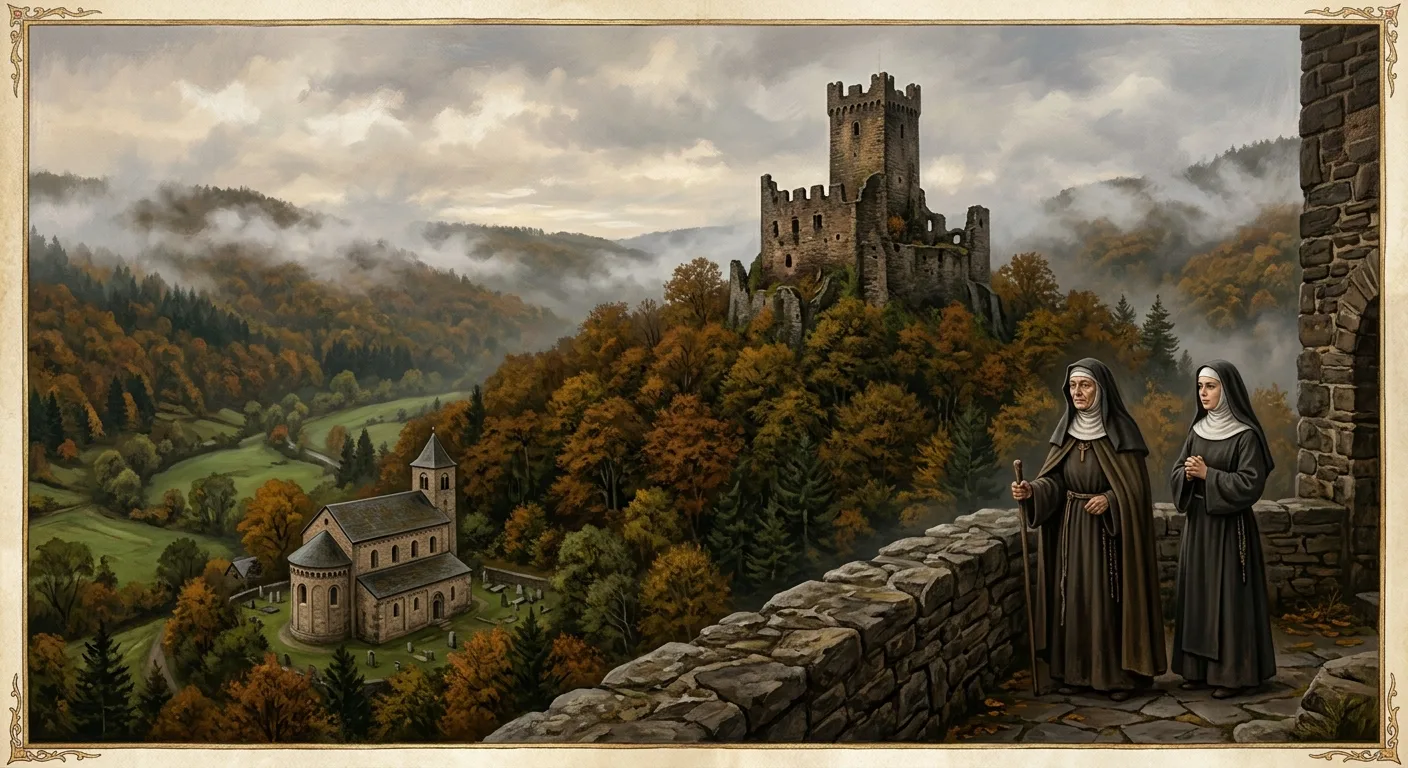
The tower of Burg Sponheim stands above the village of Burgsponheim on a wooded hill — all that remains of the castle where Hildegard was brought at age eight to begin her education under Jutta of Sponheim. A short walk away, the Romanesque church of Sponheim Monastery still stands: the only building on the entire Hildegardweg that survives from Hildegard’s own lifetime. When Hildegard and the young Jutta lived at the castle, they would have watched this church being built.
Jutta of Sponheim
Of all the relationships in Hildegard’s life, the one with Jutta is the most complex — and the one she spoke about least. On this sixth stage of the trail, she finally addresses it.
Hildegard Speaks: On Her Teacher, Jutta of Sponheim
In her text for this sixth stage, theologian and Hildegard scholar Dr. Annette Esser gives voice to Hildegard’s careful, guarded account of the woman who shaped her most.
“Jutta of Sponheim was my teacher. I was her closest confidante and became her successor as the second magistra on the Disibodenberg. For 30 years we lived together; yet for a long time I have restrained from talking about her. From Jutta, I learnt the psalms — that means I learnt to read and write Latin. I, who had been dealing with the art of healing for all these years, decided for myself not to become as strict and hostile to the body as Jutta. Yet as her closest confidante who wished to honour her heritage, I have not talked about this further to anyone.”
Hildegard von Bingen, as rendered by Dr. Annette Esser
The Teacher Who Kept Silence
Jutta of Sponheim was beautiful, devout, and drawn to severe asceticism in ways that troubled those around her. She fasted to extremes. She wore an iron chain against her flesh. She walked barefoot in winter. When she died on Christmas Day 1136 — at around 44 years of age — her body, as Hildegard gently describes, bore the marks of a lifetime of self-mortification.
Hildegard loved her. Hildegard also chose a different path. She is quietly explicit about this: she would not follow Jutta’s way of relating to the body. Her own theology and medicine were built on a fundamentally different premise — that the body was not an enemy to be subdued but a garden to be tended, a system to be kept in harmony with its environment.
The discretion with which Hildegard writes about Jutta — acknowledging the relationship without exposing its tensions — is itself a kind of wisdom. She was protecting the reputation of someone she had loved. She was also, perhaps, protecting the complexity of her own formation.
Stage 6 — Burgsponheim
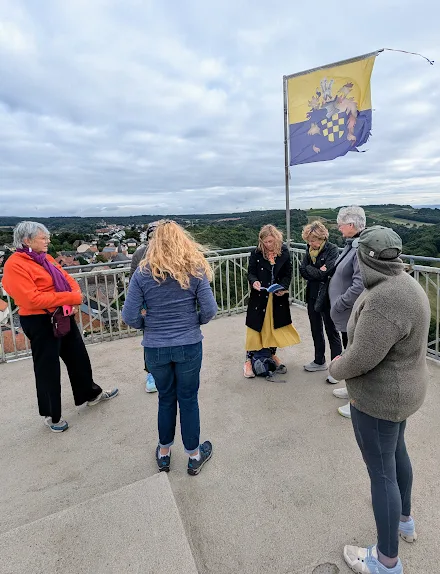
The only building on the entire Hildegardweg that survives from Hildegard’s own lifetime is located here: the tower of Burg Sponheim. If this story is pulling you toward Germany, download our free Pilgrim’s Guide and see what the trail holds.
About This Series
This post is part of a ten-stage series walking the Hildegardweg — drawing on Saint Hildegard Speaks by Dr. Annette Esser, published by Crazy Wisdom Publishing. Learn more about the Saint Hildegard Way pilgrimage journey or get in touch.